
 under-the-t-top
Best Marine LED Light Bars 2026: Buyer's Guide
Table of Contents
- What Makes the Best Marine LED Light Bars for 2026
- Marine Grade LED Light Bar IP69: What the Rating Actually Means
- Beam Patterns, Lumen Output, and Color Temperature Compared
- How to Install Marine LED Light Bars Without Damaging Your Boat
- Marine LED Light Bar Wiring Guide: Voltage, Amperage, and EMI
- Legal Compliance and Navigation Safety on the Water
- Frequently Asked Questions
Last Updated: September 17, 2026
What Makes the Best Marine LED Light Bars for 2026
The best marine LED light bars for 2026 are built around three things: corrosion-resistant materials, sealed electronics, and heat management that survives an enclosed console. This guide covers the ratings, beam patterns, wiring, and legal rules that actually decide whether a light bar lasts five seasons or one.
Most buyers learn this the hard way. A light bar that looks impressive in a product photo can fail in a single season once saltwater reaches a cheap connector.
Below, we break down what separates a genuinely marine-grade unit from a repackaged truck light, and how to install one without drilling through something you'll regret.
Saltwater Corrosion Resistance and Marine-Grade Materials
Saltwater corrosion resistance starts with the housing material, not the finish. Marine-grade aluminum with a proper powder coating resists pitting far better than painted steel, and stainless steel hardware prevents the seized bolts that plague cheap mounts. A polycarbonate lens with UV resistance also holds clarity instead of clouding after a season in direct sun.
A common mistake is judging a light bar by its housing alone. The waterproof seal around the lens and the die-cast housing joints matter just as much, because that's where water actually gets in.
Thermal Management in Enclosed Spaces
Thermal management decides how long a light bar lasts in a closed console or hardtop cavity. LEDs lose output as they heat up, and a sealed housing with no heat path traps that heat until the driver circuit degrades. Look for finned die-cast housing bodies and, where the light sits in an enclosed space, a mounting position with airflow behind it.
This is the part most guides skip.
Marine Grade LED Light Bar IP69: What the Rating Actually Means
A marine grade led light bar ip69 rating means the fixture survives high-pressure, high-temperature water jets, the toughest ingress protection level commonly applied to vehicle lighting. The "K" suffix matters: IP69K is tested with a jet of heated water (roughly 176°F at the nozzle) sprayed at close range from multiple angles, which is a harsher test than the continuous-immersion IP68 standard. That distinction is why IP69K is the rating most often cited for deck, hardtop, and bow lighting that gets hit with a washdown hose or a steam cleaner at the end of every trip.
The number matters less than the seal design behind it. An IP69K rating with a poorly sealed wiring harness entry still fails, because water enters through the connector, not the lens. Three failure points decide whether the rating holds up in the real world:
- Cable entry and strain relief. The gland or grommet where the harness exits the housing is the most common ingress path. A molded, over-molded, or compression-gland entry beats a simple rubber plug every time.
- Gasket compression and lens seating. A polycarbonate lens only seals if the gasket is compressed evenly around its full perimeter. Warped housings or over-torqued fasteners break that seal.
- Pressure-equalization breathers. A fully sealed housing pulls a vacuum as it heats and cools, which can suck water past a marginal gasket. A hydrophobic breather membrane equalizes pressure without letting water in, a detail most product listings never mention.
| Rating | Test Condition | Realistic Marine Use |
|---|---|---|
| IP67 | Dust-tight, temporary immersion (about 3 ft for 30 min) | Cabin interior, trailer-mounted fixtures |
| IP68 | Dust-tight, continuous immersion (depth and duration set by maker) | Bilge, low-mount hull fixtures |
| IP69K | Dust-tight, high-pressure hot-water jets from multiple angles | Deck, hardtop, bow, and washdown-exposed lighting |
Pair the rating with marine-grade connectors and a proper circuit protection setup. A Deutsch-style sealed connector, a fused positive lead, and a dedicated ground do more for long-term survival than the housing rating alone. And remember that IP ratings cover water and dust, not corrosion. A fixture can pass IP69K and still pit at the terminals if the connector pins aren't plated for salt exposure.
Beam Patterns, Lumen Output, and Color Temperature Compared
Lumen output tells you how much light a fixture produces; beam pattern tells you where it lands. Color temperature, measured as a kelvin rating, decides how clearly you read water, markers, and debris ahead of the bow. Match all three to your use case rather than chasing the highest lumen number.
Spot, Flood, and Combo Beam Patterns
A spot light throws a narrow, long-distance beam for picking out channel markers. A flood light spreads wide for deck lighting and close work. A combo beam blends both and suits most boats that need one fixture to do several jobs, which is why it's the most common choice for general night navigation.
Brighter isn't automatically better. Overpowered bow lighting washes out your night vision and can blind other skippers.
How to Install Marine LED Light Bars Without Damaging Your Boat
Learning how to install marine led light bar hardware correctly comes down to planning the mount, the backing, and the wire route before you drill. Choose flush mount for a clean, snag-free finish on a hardtop, or surface mount when you need to angle the beam or avoid cutting into gelcoat. Both work; the decision is about your deck layout, not which one is "better."
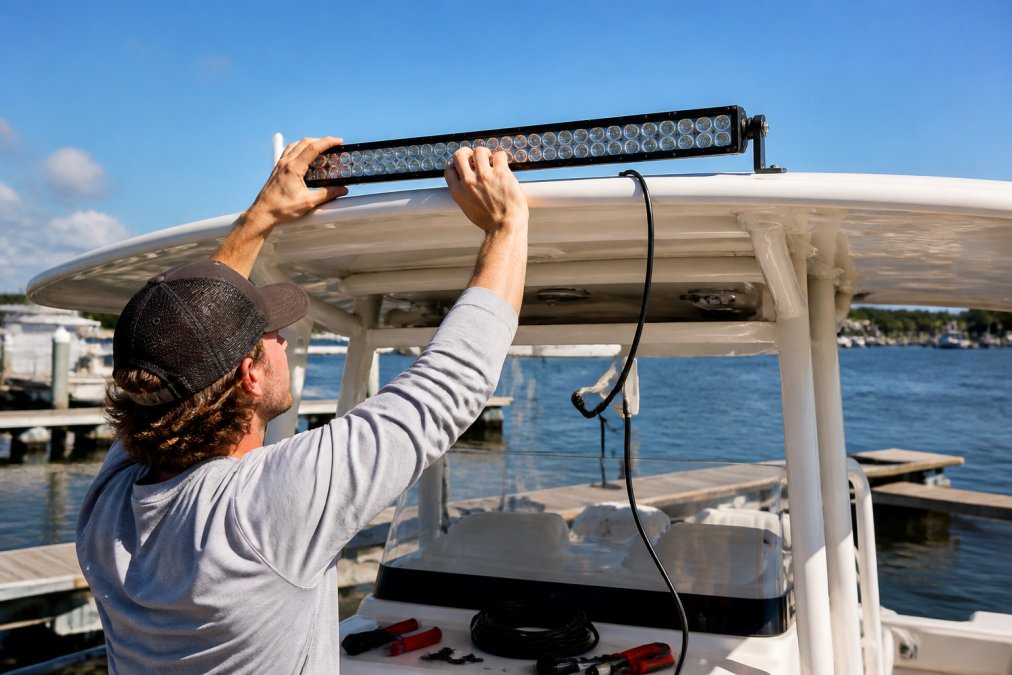
DIY vs. Professional: What the Job Actually Involves
Most guides sell you a light bar and stop there. Here's the honest labor picture, because the install is where boats get damaged.
What you actually need on hand:
- A backing plate. Through-bolting into thin fiberglass without a backing plate (starboard, aluminum, or a fender washer stack) concentrates load and cracks gelcoat under vibration. This is the single most common DIY mistake.
- Marine sealant, not silicone. Polyurethane or butyl marine sealant stays flexible and bonds to gelcoat; hardware-store silicone peels and traps water. Respect the cure window, usually 24 hours before full water exposure.
- A step bit and a pilot hole. Never drill a finished hole in one pass through gelcoat; it chips. Pilot, then step up.
- A fish tape or pull string. Pre-run a pull string through any tube or chase before you commit to a wire route.
Marine LED Light Bar Wiring Guide: Voltage, Amperage, and EMI
A marine led light bar wiring guide should start with two numbers: voltage compatibility and amperage draw. Confirm the fixture runs on your boat's 12V DC or 24V DC system, then size the wiring harness and fuse to the total amperage draw of every light on that circuit. Undersized wire overheats; oversized fuses don't protect anything.
Electromagnetic Interference (EMI) Shielding
EMI shielding keeps a light bar from bleeding noise into your marine electronics. Cheap drivers can interfere with a VHF radio, GPS, or depth sounder, especially when lights and electronics share a power path. Shielded harnesses and separate grounds reduce that risk. This is one of the most overlooked specs in budget lighting, and it's the reason a noisy bar can ruin a radio conversation mid-channel.
Legal Compliance and Navigation Safety on the Water
Legal compliance matters because deck and auxiliary lighting is not the same as navigation lighting. Under the U.S. Coast Guard navigation rules and regulations, vessels must display specific navigation lights, and adding bright auxiliary lights does not replace them. Auxiliary lights are for illuminating your own deck and work area, not for signaling other vessels.
Frequently Asked Questions
What does IP69 rating mean for marine light bars?
IP69 means the light bar is fully sealed against dust and can withstand high-pressure, high-temperature water jets from any direction. For boat owners, this matters because it covers washdowns, spray, and rain. An IP69 marine grade LED light bar will not let water into the housing or connectors, which is the main cause of premature failure in saltwater environments. Look for IP69 or IP69K on the spec sheet before buying.
How do I choose the right size light bar for my boat?
Match the bar length to your mounting space and the area you need to light. Wider bars generally produce more total lumen output but draw more amperage. Check your alternator capacity and mounting surface before committing to a size.
Will a marine LED light bar interfere with my VHF radio or GPS?
Poorly shielded light bars can cause electromagnetic interference (EMI) that disrupts VHF radio, GPS, and chartplotter signals. Choose bars with shielded wiring and a metal housing that blocks emissions. Route the light bar power cable away from antenna cables and navigation electronics. If you notice static when the bar is on, add a ferrite bead to the power line or relocate the wiring.
Can I install a marine LED light bar on an older boat with basic wiring?
Most marine LED light bars work with existing 12V DC systems, so a full rewire is rarely necessary. You will need a fused circuit, a relay for bars drawing more than 5 amps, and marine-grade tinned copper wire. If your boat has a basic switch panel, add an open fuse slot or a small auxiliary fuse block. Check the amperage draw on the spec sheet and size your wire accordingly.
Night navigation punishes lighting that wasn't built for salt, heat, and constant vibration. T-Toplights designs marine-grade LED light bars, under-gunnel strips, and spreader lights with IP69K and IP67 waterproof ratings and high-output CREE LED technology, so your setup holds up season after season. Shop the T-Toplights range to upgrade your vessel's visibility and get priority customer support on every order.